

Digital performance tips: In praise of simplicity
One of the best-known blogs on web analytics is Occam’s Razor written by Google’s Digital Marketing Evangelist, Avinash Kaushik. And Occam’s razor is the idea that if you have to choose between a number of competing theories, the simplest will normally be the best.
Perhaps there’s a hint of wishful thinking in Avinash’s choice of title, because the truth is that digital marketing is much more in thrall to the pull of complexity than simplicity.
I’m fond of Forrester’s reworking of the traditional sales funnel for the digital age:
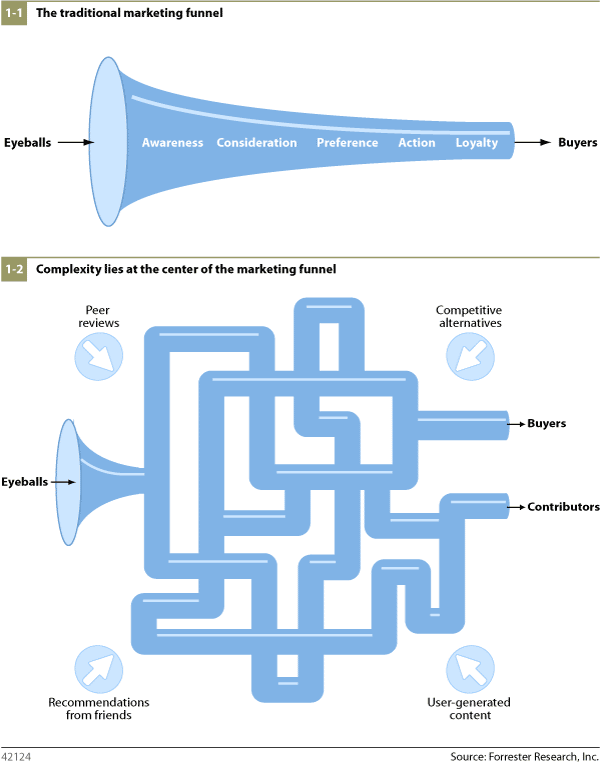
On the one hand, the reworked sales funnel probably is a more accurate picture of the way that people make purchase decisions online. But it isn’t easy to see how it would drive sensible digital strategies back in the real world.
This creates a lucrative platform for ‘big data’ style solutions, invariably talking up the role of technology and algorithms. So a typical pitch would run something like this: “We have identified 100 different factors that impact on xxxxxx, by running these through our neural network models we can score each factor and deliver a prioritised testing plan for your site.” Add into the mix a bunch of maths PhDs scratching their beards somewhere in Eastern Europe and some cloud computing magic and you have something that sounds pretty unbeatable.
Intuitively it sounds like a complex problem deserves a complex solution. But that isn’t always the case. An academic study by Wübben & Wangenheim looked at a large company deciding which of its customers should be sent a product catalogue. They tested two approaches:
- Using a simple rule of thumb – in this case whether a customer had made a purchase in the past nine months, or
- Taking multiple factors into account and then using sophisticated statistical methods like the Pareto Negative Binomial Distribution to identify the best prospects.
In this case, the complex model turned out to be less accurate at predicting inactive customers than the simple one.
With this in mind, whilst we use an amazing amount of technology across our agency, our goal is to identify crisp, simple KPIs within digital marketing that can be used to make fast and powerful decisions.
For instance, a lot of effort has gone into deprecating the role of the humble click – mostly in the context of defending channels like social which sometimes feature incredibly low click through rates. But when all is said and done, most of our clients have websites that need visitors – and without clicks, there can be no visitors. It may be too simple for our complexity-loving minds, but a click is actually a fairly accurate measure of customer interest.
Perhaps our motto as an industry should be the taken from the headline of one of the earliest Apple brochures: “Simplicity is the ultimate sophistication”.