

Our blog

The interactive brand ecosystem revisited

Nate Elliott at Forrester published an interesting post last year about the Interactive Brand Ecosystem. Essentially he is asking whether it is time that we abandoned a TV-centric planning model and worked instead on the premise that the website sits at the heart of the marketing process.

Here’s a nice diagram to show you what he is on about:
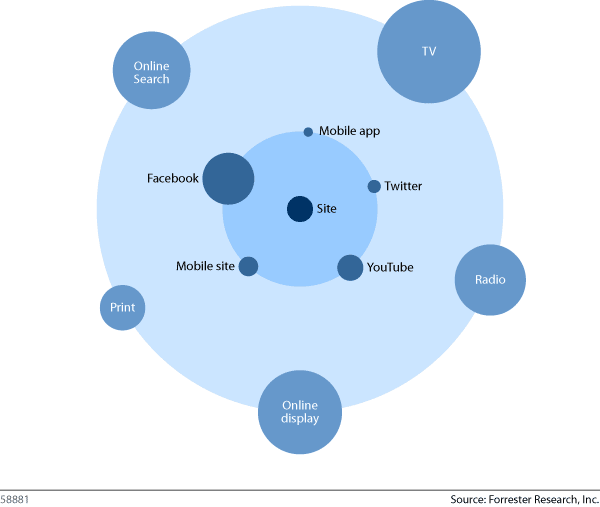
The idea is that the channels on the outer ring drive traffic into your website – and at the same time content is pushed out from your website and into social channels where prospects engage with your content and then hopefully click back into your site.

This is how it is meant to work:
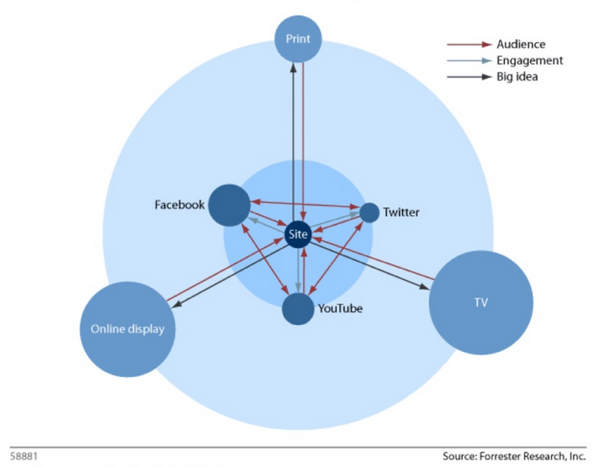
At one level, Nate is stating the obvious here – that one primary use of TV is as a drive to web channel. But he is also dead right that we still have a legacy feeling that TV should drive the entire marketing campaign from a creative or ‘big idea’ point of view.

TV will often give us rich visual content to play with – but what we really need in the digital realm is a creative idea that encourages interactivity and engagement. Putting the website at the heart of the interactive brand ecosystem forces us to think about what kind of creative idea will turn a browser into a buyer – and that is likely to be a more powerful platform for a campaign.

I don’t see this as a one-size-fits-all approach – and in fact in my next post I want to look at how the interactive brand ecosystem works with permission marketing.

One final thought is around the role of social media. Last year I saw Tom Bedecarre, the chairman of AKQA, speak at a conference and his view was that for many brands there was no point in creating a standalone brand website – they should instead be focusing on creating branded experiences on Facebook.  There’s a pretty good argument for that for FMCG brands, but I’m nervous about this approach where you have a transactional website – I think you would normally want to bring traffic to the point where they can actually buy.

So what do you think? I think this kind of mapping out of the interactive brand ecosystem is potentially a useful digital planning tool – and one that could allow digital planning to sieze the high ground of campaign planning.

 

6 Responses to The interactive brand ecosystem revisited

  1. Hi Mike

    I think that this is certainly a very interesting model to review further and refine client by client.

    I am looking at this from the online display angle. The challenge and key to this model in my view is to have a brand/advertiser that is open to looking at online:
    - More strategically and long term. Brands are often very reactive online and are prone to reviewing historic performance as the future guide to marketing activity. This is ok for short term ROI goals but it does not allow you to make strategic investments that help develop your business long term.
    - As a brand platform and so investing in creative. Too often the creative is not developed and designed to work at its best online. The most common reason for this is that the cost of the creative is seen as a pure expense that reduces the ROI of a campaign, this is a false economy in our experience and does not help the brand or the user experience in many cases and so creates a longer term decrease in the performance of display.
    - Metrics of success beyond last point of click attribution, this has been discussed a lot on the past but in reality i only know of a very small number of brands that have the analytics to carry this out.

    I hope that helps spark some healthy debate!

    Cheers Martin

  2. Good post Mike. I agree broadly with the views you express, though I don’t think the website can be the sole focus of activity in reality. I would alter that diagram by having the brand in the centre as the core but with the site wrapped around it as the site should reflect exactly the brand values and experience as it is the one place where everything is under your control. The reason the site isn’t at the centre is because most businesses do not operate only in the online world and hence consumers are interacting with them through their physical as well as virtual presence.

    The other thing to say is that brands can achieve their objectives in many different ways and whilst the website is a good way to do this, there are many other ways which means consumers don’t necessarily need to visit the site in order to deliver value to the brand. Any brand interaction wherever it happens is going to influence your perceptions whether that be in a positive or negative way, so the real answer is that a brand needs to look after each touch point with equal care, whereas certain channels are catered to far more than others as you are alluding to.

    We are half way between the old model and the new at the moment so it’s all a bit messy, with the traditional mediums still focussing on the big idea whilst digital channels are more focussed on personalisation and relevance which is pretty much the polar opposite. Until this has been played out and the new model is adopted by the more traditional channels, we will continue to be in this limbo in my view.

  3. I agree that the planning model needs to be less TV centric and that the brands big idea is best considered from a web (or at least a digital) perspective first. The big issue as I see it is many brands simply do not have a big idea. They tend to have a communications theme (usually built around a TV ad) but not a brand purpose that will connect with customers a drive engagement. To get real traction brands need to start rediscovering their ambition and purpose and reconnecting this with their customers, not simply trying the drive more sales.

  4. Pingback: The Interactive Direct Marketing Ecosystem | | Harvest Digital

Leave a Reply

Your email address will not be published. Required fields are marked *

*

You may use these HTML tags and attributes: <a href="" title=""> <abbr title=""> <acronym title=""> <b> <blockquote cite=""> <cite> <code> <del datetime=""> <em> <i> <q cite=""> <strike> <strong>